

Picture a lean, athletic 70 kg guy walk up to a loaded barbell and pull 180 kg like it is a bag of laundry, while the much bigger lifter beside him grinds out the same weight. It looks like it breaks physics. It does not. The big guy trained his muscles to be large. The lean guy trained his nervous system to be efficient. Strength and size are related, but they are not the same thing, and if you want to get a lot stronger without adding much size, you train hard for the first and deliberately sidestep the second: heavy low-rep lifting, long rest, and eating at maintenance. Here is the honest version of how, and where the popular advice oversells it.
Strength is mostly a nervous system skill
Getting stronger is not only about growing bigger muscles. A large part of strength, especially early on, is your nervous system learning to use the muscle you already have. Three things drive it: recruiting more muscle fibres at once, firing them faster, and coordinating the muscles around a lift so they work together instead of fighting each other. On top of that, heavy training thickens the contractile, force-producing part of the muscle rather than just puffing it up with fluid and glycogen. That density is what people mean by the steel-cable look instead of the water-balloon look. For the claim that heavy, low-rep work builds strength with far less size than moderate-rep pump training, the evidence is Strong.
The core protocol: heavy, low reps, long rest
The recipe is simple and a little boring.
- Lift heavy: around 85% of your one-rep max and up.
- Keep reps low: one to five per set.
- Use compound lifts: squat, deadlift, overhead press, weighted pull-up.
- Rest long: three to five minutes between sets.
The long rest is the part most people get wrong. Heavy singles and triples run on the phosphagen system, a small, fast fuel tank that takes a few minutes to refill. Rush back after 45 seconds and you are lifting on fumes: your bar speed drops and you drift back toward fatigue-and-pump training instead of pure strength. If you are gasping and drenched during a strength session, you are training the wrong quality. Rest properly, then lift with full intent.
Two ways to lift more today, for free
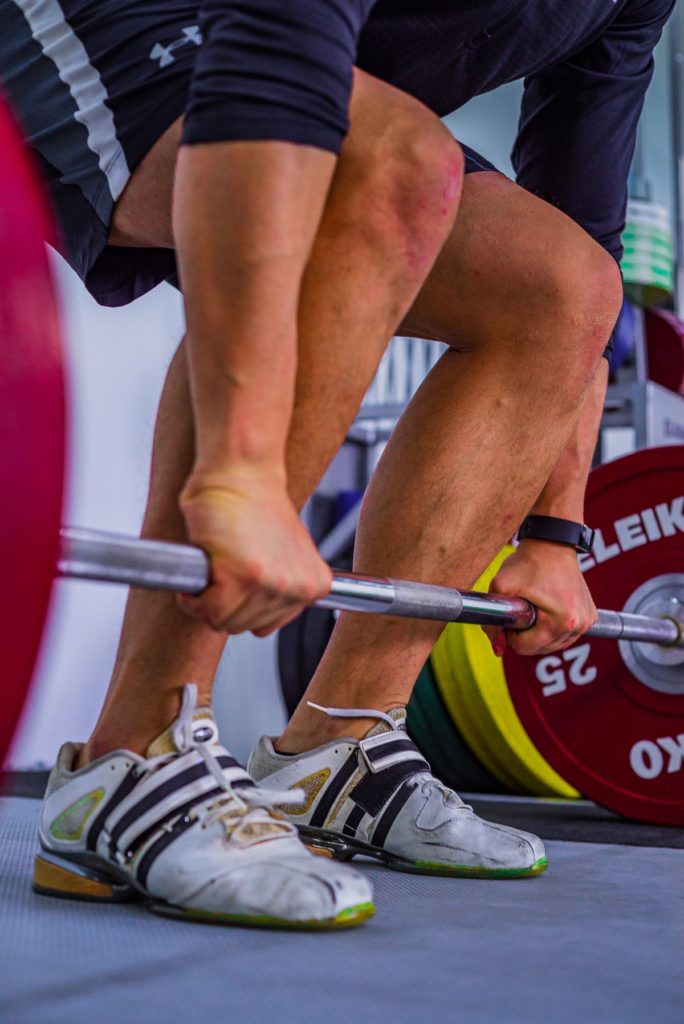
Before you add a single kilo, you are probably leaving force on the table. There is a neurological principle called Sherrington’s law of irradiation: a muscle contracting hard pulls its neighbours into the effort. In practice, full-body tension makes any lift feel more solid. Crush the bar like you are trying to leave fingerprints in the steel, brace your stomach as if about to take a punch, and squeeze your glutes. That tension spreads up the arms, locks the shoulders, and stiffens the core, giving you a more rigid platform to press or pull from. The exact gain varies, and the 10 to 20% figure often quoted is on the optimistic side, but the effect is real and it costs nothing. Grade it Moderate.
When you stall, break the plateau
Neural gains come fast, then slow. When your numbers freeze after a couple of months, do not just pile on reps. Borrow from powerlifters:
- Isometrics: hold the bar dead still at your weakest point (say, halfway up a bench press) for a few seconds. You produce huge force when nothing is moving, and it builds strength exactly where you are weakest.
- Eccentrics (negatives): you can lower more than you can lift. With a spotter, take a heavier-than-max weight and lower it slowly over four or five seconds. Strong stimulus, less of the fluid pump.
- Cluster sets: break a hard set into single reps with 15 to 20 seconds between them, so you bank more quality reps at a heavier load than a straight set allows.
- Pause reps: kill the bounce. Pause the bar still on your chest, or at the bottom of a squat, for a two-count so the muscle does all the work with no momentum.
None of these are magic. They are just honest ways to keep giving the nervous system a reason to adapt.
How to stay lean while you get strong
Here is the part the flashy versions get half right. Strength is largely a neural skill, but muscle size is thermodynamic: you cannot add much muscle without eating in a calorie surplus. So if you want to get stronger while staying roughly the size you are, eat at maintenance, roughly what you burn in a day, and keep protein high to support recovery. The evidence points to somewhere around 1.6 to 2.2 g of protein per kg of bodyweight, near the top of that range if you are lean and training hard, which is close to the classic one gram per pound (I break the numbers down in how much protein you need).
Two honest caveats. First, if you are a beginner or quite skinny, you will gain some muscle no matter what, because you have easy adaptation to make and a thicker rope simply holds more tension. That is fine. The goal is to maximise the density and efficiency of the muscle you have, not to inflate it. Second, “double your strength with zero change in size” is a great hook but an optimistic promise. Expect large, fast gains if you have only ever trained for the pump, and steadier, harder-won progress after that.
How I train it
This is close to how I actually lift, because relative strength, strength for my bodyweight, is what matters for martial arts and calisthenics. I bias heavy compound lifts in the low-rep range, rest properly between sets, and eat around maintenance so the sport is supported rather than buried under extra mass. It is the practical side of the strength versus volume choice: pick your lever, then train it honestly. And because the loads are heavy, form and recovery are not optional, which is why I am strict about warming up and managing load.
The simple plan
Keep it devastatingly simple. Pick three or four compound lifts. Train them three days a week. Keep the reps between one and five. Rest three to five minutes. Squeeze the bar until your knuckles go white. Eat at maintenance with high protein. Do that consistently and in a few months you will move weights that surprise the biggest person in the room, without buying a bigger wardrobe.
So which are you actually chasing right now, the number on the bar or the look in the mirror? For most people the honest answer is both. Now you know how to weight the dial toward strength.
Leave a Reply