

Stretching is sold as two things at once: the warm up that gets you ready to perform, and the insurance policy that keeps you injury free. The honest science says it is not quite either of those. But stretching, used the right way and at the right time, genuinely improves how you move and how you perform. The trick is knowing which kind to do, and when.
The short version
Do dynamic stretching before you train or compete, because it warms the muscle and improves range without costing you power. Save long static holds for building flexibility over time, done on their own or after a session, not in the minutes before an explosive effort. Stretching on its own does little to prevent injury. Strength through a full range of motion does far more.
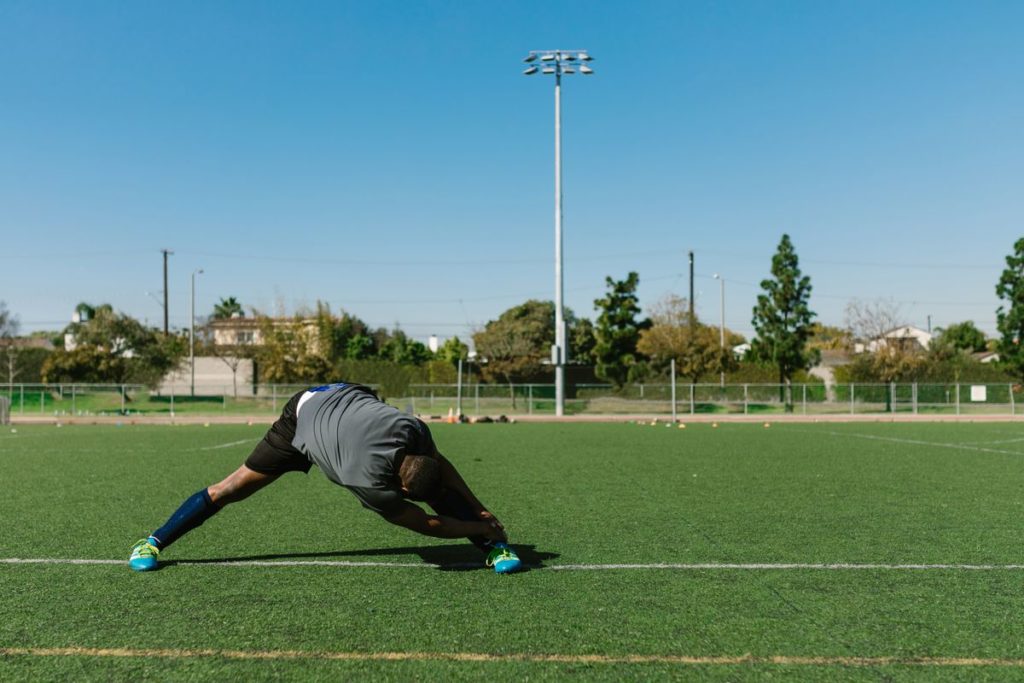
The two kinds of stretching
Dynamic stretching means moving a joint through its range under control: leg swings, lunges with a reach, arm circles, gradually bigger and faster. Static stretching means holding a lengthened position still for a stretch of time. They are not interchangeable. They do different jobs, and the mistake most people make is using the wrong one at the wrong moment.
What helps performance before you train
A dynamic warm up raises muscle temperature, wakes up the nervous system, and takes your joints through the range you are about to use. That combination improves power, sprint speed, and jump height compared with going in cold. Long static holds before performance do the opposite: holding a stretch for a minute or more just before a maximal effort can temporarily reduce strength and power by a small but real amount (Simic and colleagues, 2013). The effect fades quickly and is modest, but if you are about to lift heavy, sprint, or spar, there is no reason to hand it away. Grade this Moderate. Warm up dynamically instead.
Where static stretching earns its place
Static stretching is still worth doing. It is how you build lasting range of motion, and range is what lets you get into strong positions in the first place: a deep squat, a full overhead reach, a high kick. The fix is timing. Do your longer holds on their own, on a rest day or well after training, when a brief dip in power does not matter. If you train a striking or grappling art, this range work is not optional. It underpins the fundamentals, and it pairs with the balance and strength work that keeps you moving well for decades.
The injury myth
This is the claim to be honest about. Stretching before exercise, on its own, does not meaningfully reduce most injuries (Behm and Chaouachi, 2011). What does protect you is a proper warm up, sensible loading, and building strength through a full range of motion so the tissue is robust where it is long. In other words, mobility plus strength, not mobility alone. That is the same principle behind training without getting hurt. Stretch because it helps you move and perform, not because you think it is a force field.
How I use it
Before a session I warm up dynamically: joint circles, swings, and lighter versions of the movements I am about to do. I keep my longer static and mobility work separate, usually on easier days, because martial arts demands real range and I want to own those positions under control. And I never chase flexibility for its own sake. I chase strength through the range I actually use, which for most people is the version of flexibility that carries over to sport and life.
Stretching is a tool, not a ritual and not a shield. Warm up dynamically, build range deliberately, and get strong through that range. Do that and stretching quietly improves everything you do. So which one have you been getting wrong, the timing or the type?
Leave a Reply